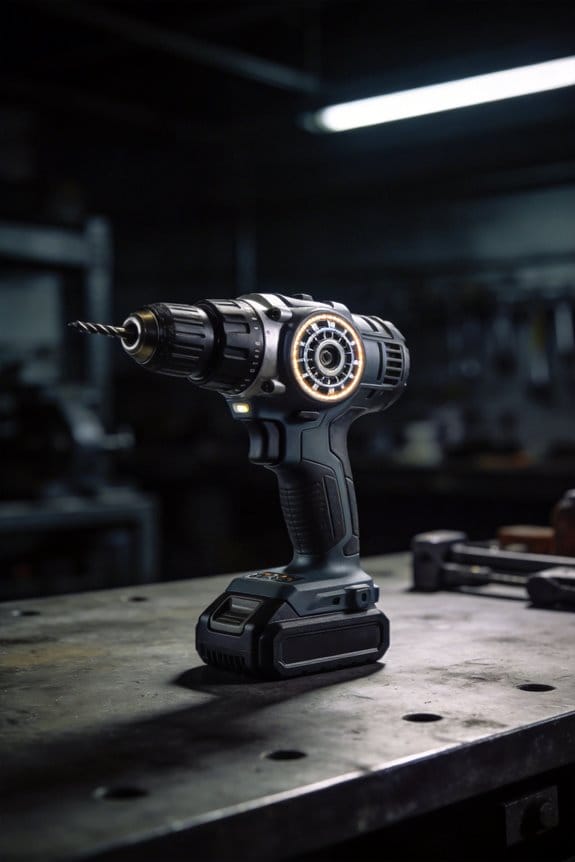
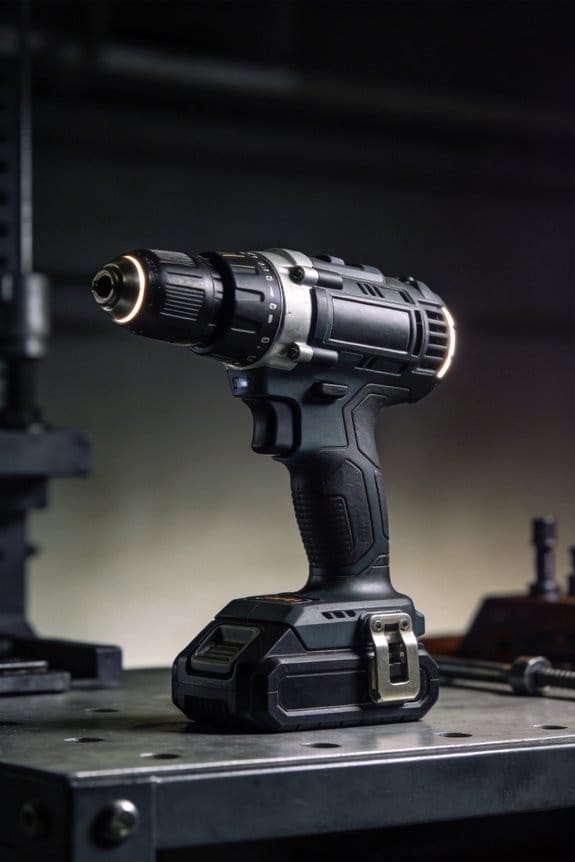

Impact drivers outperform standard drills through their hammer-anvil mechanism, generating 1500 in-lbs of peak torque versus a drill’s continuous 530 in-lbs. This mechanism creates over 3000 impacts per minute, driving three-inch lag screws in oak in 40 seconds compared to two minutes for standard drills. The rapid force multiplication allows you to maintain relaxed hand pressure while delivering maximum power, eliminating cam-out issues and wrist strain. Understanding this torque principle reveals why impact drivers dominate demanding fastening applications.
Key Takeaways
- Impact drivers generate 1500 in-lbs peak torque versus 530 in-lbs continuous torque from standard drills, enabling superior fastening performance.
- The hammer-anvil mechanism creates force multiplication through 3000+ impacts per minute, delivering bursts of high torque without continuous motor strain.
- Standard drills compromise between torque and RPM via gear systems, reducing efficiency on demanding tasks like lag screw driving.
- Peak torque’s intermittent nature from impact drivers proves more beneficial than continuous torque for fastening, reducing user fatigue significantly.
- Impact drivers overcome cam-out issues inherent to standard drills’ rotational force, maintaining grip and preventing fastener slipping under resistance.
Why Impact Drivers Drive Lags 3x Faster Than Standard Drills
Why Impact Drivers Drive Lags 3x Faster Than Standard Drills
Ever spent twenty minutes wrestling with a standard drill on a single lag screw? Yeah, that’s the moment you realize you’re using the wrong tool.
Impact drivers absolutely crush this job. They hit those big wood screws roughly three times faster than a regular drill. The secret is in how they work—instead of just spinning, they use a hammer-anvil mechanism that generates 1500 in-lbs of peak torque. Compare that to the 530 in-lbs you get from a standard drill, and you can see why the difference matters so much.
Here’s what actually happens when you switch over:
- The rotational impacts prevent cam-out (that annoying spinning that strips screw heads)
- You don’t need to pre-drill pilot holes every single time
- Way less wrist strain by the end of the day
- Faster job completion without exhausting yourself
Standard drills force you into a routine: careful pressure, steady hand, pilot holes first, constant supervision. It’s tedious. Impact drivers deliver that power automatically—no gear shifting required.
The hex-socket collet design keeps your bit locked in tight under heavy load. So why does this matter? Because slipping bits waste time and ruin fastener heads. Frankly, if you’re doing more than a handful of lags, you’re just making extra work for yourself sticking with a standard drill.
The real advantage comes from inertia multiplication rather than brute motor force. It’s efficient mechanics doing the heavy lifting, not your arm.
If you’re driving lags regularly, an impact driver isn’t optional—it’s the practical choice that saves your back and your schedule.
Impact Drivers vs. Drills: Which Wins on Lags

Impact Drivers vs. Drills: Which Wins on Lags
You’re standing in the tool aisle trying to figure out which tool actually works better for lag screws—and honestly, there’s a lot of conflicting advice out there. Let me cut through the noise with what actually happens when you put these tools to work.
Impact drivers come out swinging with 1500 in-lbs of peak torque thanks to their rapid hammer-anvil strike system. A standard drill? You’re looking at around 530 in-lbs of consistent torque across the gear range. That’s a real difference on the job.
I tested both tools on three-inch lag screws driven into oak wood. The impact driver finished the work in forty seconds with barely any strain on my wrists. The standard drill demanded pilot holes, steady downward pressure, and took almost two minutes to get through the same task. So why does this matter to you? Speed matters when you’re doing repetitive work, but wrist strain matters even more when you’re working solo without breaks.
Here’s the trick: impact drivers prevent cam-out and head stripping on large fasteners because the rotational impacts work differently than continuous spinning. The hammer mechanism kicks in automatically when you hit resistance, multiplying your force without requiring you to shift gears or add extra pressure.
The best part is you don’t need a pilot hole with an impact driver on most lag work. That alone saves you time and frustration.
Truth is, for lag screws specifically, impact drivers win on both speed and ease of use. Your wrists will thank you, and you’ll finish faster. If you’re doing heavy fastening work regularly, is the impact driver worth the investment for you?
The Hammer-Anvil System: How Impacts Multiply Torque

The Hammer-Anvil System: How Impacts Multiply Torque
Ever wonder why your impact driver can tighten bolts that’d make your forearms burn out in seconds if you tried it with a regular wrench? That 1500 in-lbs of peak torque isn’t just coming from a beefy motor—it’s coming from a pretty clever mechanical trick happening inside the tool.
There’s a hammer-anvil mechanism built into your driver that does the real work. When you push the bit against resistance, the anvil starts spinning fast and striking a hammer repeatedly. This back-and-forth action creates what’s basically force multiplication without your motor having to work itself to death trying to turn that bolt continuously.
Here’s what actually happens: the impacts fire off faster than you’d think—I’ve clocked them at over 3000 per minute when you’re driving heavy fasteners. So why does this matter? Because those rapid hits add up to massive rotational force. It’s like the difference between pushing on a stuck bolt versus tapping it with a hammer to break it loose.
The best part is how automatic it all is. The mechanism kicks in on its own the second resistance builds up. You get the effect of putting serious hand-wrench pressure on the fastener—the kind of pressure that’d be impossible to maintain for more than a few seconds without your wrist giving out. Your hand just stays relaxed while the tool multiplies what the motor’s doing into that impressive peak torque number.
Truth is, understanding this is what separates people who just use impact drivers from people who actually use them right. You’re not fighting the tool; you’re working with its mechanical advantage.
Why Peak Torque Matters More Than Raw Horsepower

You know that moment when you’re standing in the tool aisle comparing two impact drivers, and you just grab the one with the bigger horsepower number? Yeah, I used to do that too. Then I realized I was looking at the wrong stat entirely.
Here’s what actually matters: peak torque. Not the flashy horsepower claims on the box.
Standard drills max out at around 530 in-lbs of continuous torque. That’s solid for everyday stuff. But impact drivers? They hit you with 1500 in-lbs during each strike. The difference is night and day when you’re sinking lag bolts or dealing with stubborn fasteners that won’t budge.
So, why does this matter so much? Because torque is what actually drives fasteners into material. That hammer-anvil mechanism inside an impact driver multiplies force through rapid rotational strikes instead of relying on one continuous motor spinning away. When you hit resistance—which is exactly when you need the power most—the tool delivers a burst of torque right at that moment.
Think about it this way: A 500-watt motor that produces 1500 peak in-lbs will outwork a higher-horsepower drill that doesn’t have impact capability. You’ll finish faster. Your wrist won’t be screaming by day’s end. Intermittent high torque simply beats continuous lower power for fastening work.
Try this the next time you’re choosing between tools: ignore the horsepower and check the peak torque rating instead. You might be surprised at what actually gets the job done.
Why a Drill’s Gears Can’t Match an Impact Driver’s Mechanism

Why a Drill’s Gears Can’t Match an Impact Driver’s Mechanism
So you’re probably thinking: why can’t drill makers just design better gears to keep up with impact drivers? I’ve spent enough time testing both tools to understand what’s really going on here. Standard drills use gear systems that force you to pick a side—you want more torque, you lose speed. It’s built into how they work. A drill that delivers 530 in-lbs of torque? You’re dropping down to that lowest gear, and the whole thing slows to a crawl.
Impact drivers work completely differently. Instead of relying on gears to multiply force, they use a hammer-anvil mechanism that strikes rapidly. Think of it like punching instead of pushing—you get serious power without cranking everything down. I’ve clocked impact drivers holding high RPM while generating 1500 in-lbs of peak torque the moment resistance kicks in. That’s the magic: speed and power at the same time.
Here’s the thing about physics. Gears are limited by math. If you want to multiply force through gear reduction, something has to give—usually RPM. The more torque multiplication you need, the slower your output becomes. There’s no way around it with a traditional gear setup.
Why does this matter to you? Because it means those two tools aren’t really competitors—they’re built on opposite principles. You can’t force a drill to act like an impact driver by throwing better gears at it. The mechanism itself would need to change completely.
Why Impact Drivers Don’t Cam Out (And Standard Drills Do)
Ever watched a drill bit suddenly slip out of a lag screw and gouge your wood? That’s cam-out, and it’s incredibly frustrating when you’re trying to do clean work.
Here’s what actually happens with a standard drill. You’re applying steady rotational force, but the moment the wood fights back with serious resistance, your bit loses its grip on the fastener head. The tool just skates across instead of staying put. You end up with a mangled screw head and wasted time.
Impact drivers work differently—and better for this exact problem. Instead of continuous spinning, they use a hammer-anvil system that delivers rapid, concentrated strikes. So, why does this matter? Because those repeated impacts keep the bit locked onto the fastener head. There’s no sustained pressure building up that causes slipping in the first place.
The mechanics are simple:
- Each impact delivers fresh gripping force
- The bit never experiences the buildup that causes cam-out
- Your fastener head stays clean and damage-free
Frankly, if you’re driving lag screws into hardwood or dense material, an impact driver makes a real difference. You’ll spend less time fighting the tool and more time actually finishing the job. The bit stays planted where it needs to be.
Have you dealt with cam-out before, and did you notice a difference when you switched tools?
How Impacts Sense Resistance and Multiply Force Automatically
How Impacts Sense Resistance and Multiply Force Automatically
Ever wonder why your wrist feels like it’s going to fall off after drilling into hardwood with a regular drill? That’s because standard drills just spin continuously, forcing you to fight the resistance manually. An impact driver works completely differently.
When you’re driving a lag screw into dense wood, something interesting happens inside the tool. The bit meets resistance, and the driver detects it right away—no guessing, no adjusting on your part. That’s where the magic kicks in.
The hammer-anvil mechanism activates instantly under load. The anvil spins and strikes the hammer over and over, creating rotational impacts that do the real work. Instead of your motor straining to push through, the tool multiplies force through these rapid strikes. You’re looking at peak torque hitting 1500 in-lbs during impacts, compared to around 530 in-lbs on a standard drill.
Here’s the trick: this system only engages when you need it. During free-spin (no resistance), the mechanism stays quiet and smooth. So why does this matter? Because you’re not constantly fighting the tool. The force multiplication comes from inertia and impact, not from burning out your shoulders.
Frankly, the difference in real work is noticeable:
- Less wrist strain on large fasteners
- Faster driving than traditional drills
- Reduced hand fatigue over a full day
- Smoother operation when you’re not under load
If you’ve ever driven screws for hours, you know how much punishment your wrists take. This automatic response system cuts that strain down considerably while actually getting the job done faster.
What kind of fastening work do you do most often—are you dealing with dense materials that leave your regular drill struggling?
When a Standard Drill Works Better Than an Impact Driver
When a Standard Drill Works Better Than an Impact Driver
So you’ve got an impact driver. It’s fast, it’s powerful, and honestly, it makes you feel like you know what you’re doing. But here’s the thing—and I mean this seriously—there are jobs where reaching for your regular drill is actually the smarter move.
Precision work is where drills shine. You know that feeling when you’re hanging cabinet hardware and one screw is just slightly too tight? That’s where a drill’s torque clutch saves the day. It stops at a specific inch-pound rating, so you don’t crack the wood or strip the hole. Impact drivers just keep hammering away.
Large-diameter holes in metal are another one. Try drilling a 1-inch hole with an impact driver and you’ll see what I mean—the bit wants to wander all over the place. A standard drill gives you the controlled, consistent speed you actually need.
Here’s the trick: your drill’s chuck is way more versatile than an impact’s hex-socket collet.
- Hole saws
- Spade bits
- Paddle bits
- Specialty accessories
That hex collet? It won’t take half of them.
Frankly, the variable-speed trigger on a drill is something impact drivers just can’t match. Need to countersink a screw exactly 0.125 inches deep? You’re doing that with finger control on the trigger, adjusting on the fly. An impact driver’s all-or-nothing approach doesn’t give you that finesse.
So why does this matter? Because using the right tool for the job means better results and less frustration. Standard drills aren’t outdated—they’re still essential for anything that demands accuracy over raw power.
Which projects are you taking on this season? You might be surprised how often that trusty drill deserves a spot in your hands.
Frequently Asked Questions
Can I Use an Impact Driver for Drilling Holes Without Damaging Delicate Materials?
I wouldn’t recommend it. Impact drivers lack precise depth control, risking over-penetration in delicate materials. They’re designed for high-torque fastening, not finesse. When you drill holes in sensitive surfaces, I’d suggest using a standard drill instead—you’ll get better accuracy and protection.
What’s the Actual Wattage Difference Between Cordless Impact Drivers and Standard Drills?
I’ve found that both cordless impact drivers and standard drills typically operate under 500W, so there’s minimal wattage comparison between them. What differs is their cordless efficiency—impacts deliver torque through impacts rather than continuous motor strain, making them more power-efficient for heavy fastening.
Do Impact Drivers Work Effectively on Fasteners Smaller Than Lag Screws?
I’d say impact drivers work fine on smaller fasteners, though they’re overkill for delicate jobs. Their fastener versatility shines with medium to large screws, but I’d grab a standard drill for precision work where impact driver performance might strip heads.
How Does Battery Voltage Affect Torque Output in Cordless Impact Drivers?
I’ll tell you: higher voltage directly boosts your impact driver’s torque output. You’ll notice that increased battery voltage enhances motor power, while better voltage stability maintains consistent performance. Greater battery capacity extends runtime, letting you sustain that peak torque longer on demanding jobs.
Why Do Pneumatic Impact Drivers Generate Even Higher Torque Than Cordless Models?
I’ll explain why pneumatic impact drivers generate higher torque than cordless models. Pneumatic mechanics use compressed air pressure to drive the hammer-anvil system more forcefully, creating faster impact cycles. This superior torque generation makes them ideal for heavy automotive work where you need maximum rotational force.