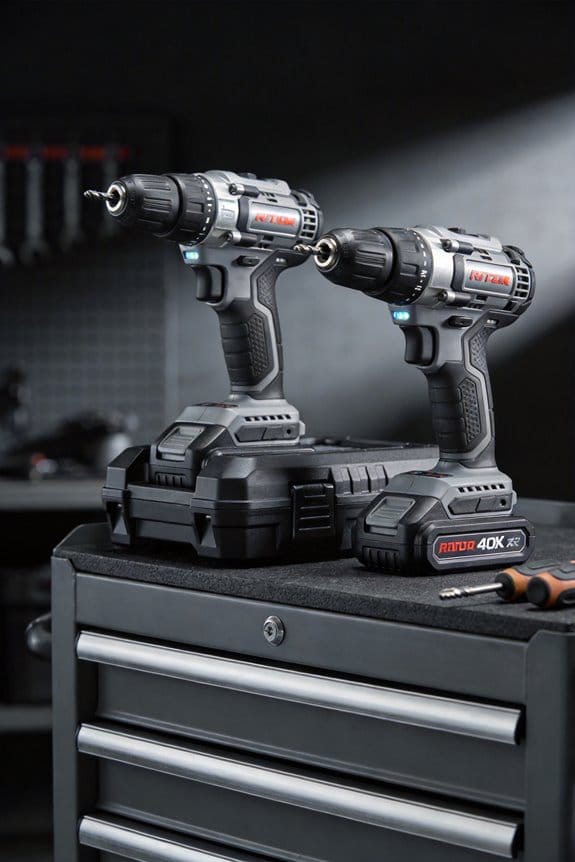

Combo kits pair drills and impact drivers because each excels at different tasks. Drills provide controlled rotation for pilot holes with variable speeds protecting delicate materials. Impact drivers deliver 1,500 to 2,000 inch-pounds of torque, driving fasteners without stalling or bit slip. Together, they eliminate constant bit swapping and speed adjustments that waste jobsite time. Lighter compact designs under 3.6 pounds reduce fatigue during extended overhead work. Kits cost 15-25% less than separate purchases while including dual batteries and chargers. Understanding which tool handles specific applications reveals why professionals standardize this combination.
Key Takeaways
- Impact drivers and drills serve complementary functions, with drills providing precision and impact drivers delivering high torque for fastening efficiency.
- Combo kits reduce jobsite inefficiencies by eliminating constant tool swapping and speed adjustments, enabling smoother workflow and faster project completion.
- Ergonomic design of both tools minimizes fatigue during extended use, particularly for overhead work, improving productivity and worker comfort throughout the day.
- Combo kits cost 15-25% less than purchasing individual tools separately while including batteries, chargers, and carrying cases for added value.
- Dual-battery systems and brushless motors enable continuous work with simultaneous charging, ensuring consistent performance for demanding framing and fastening applications.
Why Single Tools Cost You Time and Money on Every Job

Why Single Tools Cost You Time and Money on Every Job
Ever notice how you’re constantly swapping bits on a jobsite, losing your groove every time you switch from drilling to driving? That’s what happens when you try to do everything with one multipurpose tool.
I’ve spent enough time on job sites to see this play out over and over. The math is simple: every time you switch between drilling pilot holes and driving fasteners, you’re burning minutes. You adjust speed settings, swap bits, change your grip. It adds up fast, especially across a full day or a bigger project.
Here’s the thing about compromise—a single drill-driver just can’t excel at both jobs equally. Your motor has to make trade-offs. Impact drivers deliver 1,500 to 2,000 in-lbs of torque, which is what you actually need for driving fasteners. Drills, on the other hand, are built for consistent-speed boring and control. Trying to split the difference means you’re never getting the best performance from either.
So, why does this matter to your workflow?
When contractors carry both tools at once, they keep moving. No stopping to fiddle with settings. No waiting around for one tool to do the job it wasn’t really designed for. The work flows smoother, and you don’t burn out as fast.
Honestly, the professionals do this for a reason. They know that carrying two specialized tools beats lugging one jack-of-all-trades around every single time. Your back thanks you, your timeline thanks you, and your finished work thanks you.
Next time you’re gearing up for a job, ask yourself: are you really saving weight by carrying one tool, or are you just losing time?
Drilling Pilot Holes vs. Driving Fasteners: What Each Tool Does Best
Drilling Pilot Holes vs. Driving Fasteners: What Each Tool Does Best
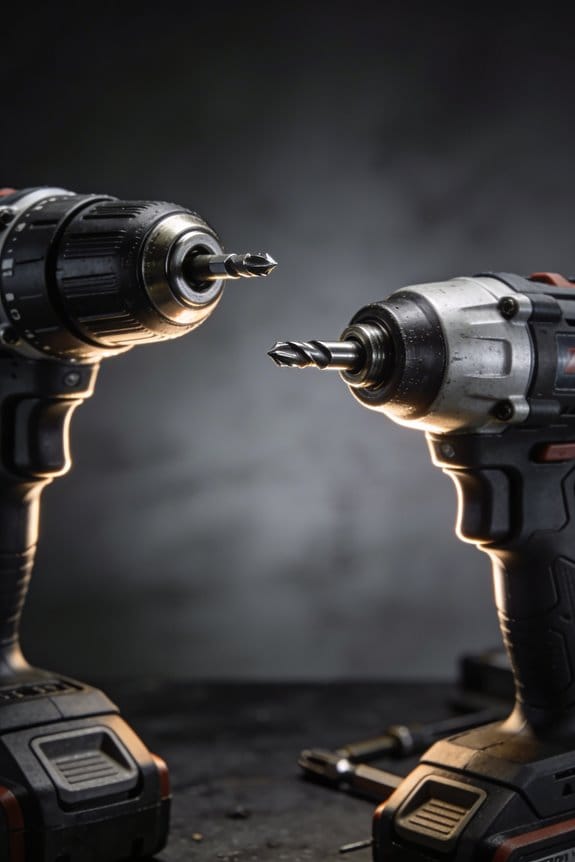
Ever grab the wrong tool for a job and spend twice as long finishing it? That’s what happens when you try to use one tool for everything. Truth is, drills and impact drivers do completely different things, and trying to make one do both jobs just doesn’t work.
Here’s the difference: a drill gives you steady, controlled rotation that you can dial in. With variable speeds dropping as low as 0-600 RPM, you’ve got the finesse you need when working with delicate materials. You’re not fighting the tool—you’re working with it. That control matters when you’re setting pilot holes in trim work or soft wood where one slip ruins your piece.
Impact drivers are built for a totally different mission. They hammer and twist at the same time, generating serious torque—we’re talking 2,000 in-lbs on models like the Milwaukee M18 Fuel. That pulsing action is what lets you break loose a stuck screw that a regular drill would just spin and spin on.
So why does this matter? Because the right tool doesn’t just work faster—it actually works better.
In my experience, keeping these tools separate cuts project time significantly. Framing work that takes hours with a drill? An impact driver handles it in maybe 60% of that time. You’re not constantly switching between tasks or fighting the tool’s limitations. Your hands don’t get as tired either, which makes a real difference on long days.
The best part is you’ll stop breaking screws and damaging materials once you match the tool to the job. Try this: use your drill for anything that needs precision or finesse, and reach for the impact driver when you need raw power and speed.
Want to know which tool you actually need for your next project?
Torque and Speed: Impact Drivers Beat Standard Drills for Fastening

Torque and Speed: Impact Drivers Beat Standard Drills for Fastening
Ever grabbed a standard drill for a serious fastening job and just felt… underpowered? That’s because you were. Impact drivers deliver somewhere between 1,500 to 2,000 in-lbs of torque, while traditional drills fall way short when you’re trying to drive heavy fasteners. The difference isn’t subtle.
Milwaukee M18 Fuel models crank out 2,000 in-lbs, which is what you want if you’re tackling demanding work. HART and Craftsman sit at 1,700 and 1,500 in-lbs respectively—still plenty solid if you’re not maxing out your tool’s capabilities every single day.
So, why does this torque number actually matter? The impact mechanism pulses force in rapid bursts instead of grinding away with steady pressure. That pulsing action keeps your bit from slipping when you’re driving into something tough, and you don’t have to white-knuckle the tool to make it work. Your wrists will thank you for that.
When you’re working with large-diameter fasteners or structural screws, the speed difference becomes obvious right away. Dense hardwoods? Corroded bolts stuck in place? This is where impact drivers shine. You’re not fighting the tool—it’s doing the heavy lifting for you.
Here’s the trick: the torque-to-weight ratio on these tools means less fatigue over a full day of work. If you’re running fasteners all day long, that matters. Your shoulders, arms, and hands notice the difference between a 4-pound drill and a properly-balanced impact driver.
What fastening jobs have left you exhausted before? That’s probably the moment you need to switch tools.
Where You’ll Actually Use This Combo: Decking, Framing, and Repairs
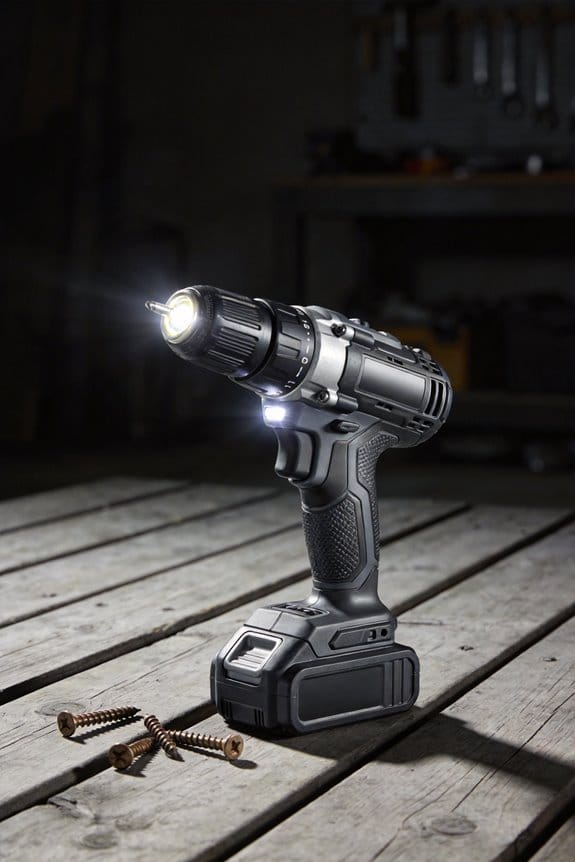
You’re standing on a half-built deck with pressure-treated lumber stacked everywhere. Your arm’s already tired, and you’ve got dozens more fasteners to drive. Sound familiar? This is exactly where having both a drill and an impact driver stops being nice-to-have and becomes absolutely necessary.
The drill handles the setup work perfectly. Use the variable-speed control to drill pilot holes at a steady pace without burning through your material. Then—and here’s where it gets real—you grab the impact driver and knock out those 3-inch lag screws without breaking a sweat or stalling the tool halfway through.
Framing work is where these two tools really prove their worth. Structural fasteners through doubled-up joists need serious power, and that’s exactly what an impact driver’s 1,500 to 2,000 in-lbs torque range delivers. The drill gets you started; the impact driver finishes the job.
So why does this matter on repair jobs? When you’re fixing existing projects in tight corners or underneath structures, the compact impact driver fits where a regular drill just won’t go. You’re not twisting your wrist into weird angles or trying to force a bulky tool into a cramped space.
Here’s the real benefit: the lightweight design means your hands and shoulders don’t feel destroyed after eight hours of fastening. Professional contractors stay on longer jobs because they’re not exhausted by day’s end. You spend less energy fighting the tools and more time actually getting things done.
The combination isn’t complicated—it’s just practical. One tool for precision, one tool for power. That’s it.
Lighter, Faster, Less Tiring: Ergonomic Wins That Add Up Over a Day

When you’re fastening things all day long, your tools either work for you or against you. By hour five, you’ll feel the difference between lugging around a heavy drill and grabbing something lighter.
Impact drivers are built different. They’re compact and way lighter than traditional drill/drivers, which means your shoulders and forearms won’t be screaming by quitting time. Overhead work—like framing or hanging cabinets—gets a lot easier when you’re not fighting gravity and tool weight at the same time.
Here’s what actually happens inside these tools. Instead of one concentrated force bearing down, the impact mechanism fires off rapid pulses. That sounds like a small detail, but it makes a real difference for your wrists and hands during the kind of repetitive work that usually leaves you sore.
Better weight distribution also helps when you’re bouncing between tools. You’re not constantly readjusting your grip or compensating for an awkward design. Try this: spend a full day with the wrong tool, then switch. You’ll notice immediately.
Variable-speed torque control on both tools matters too. You can dial back the power when you’re working with softer materials, which means less risk of stripping screws or exhausting yourself by fighting the tool.
So, why does all this add up? Because ergonomics compound over time. You won’t feel a huge difference in hour one, but by day’s end—or by the end of a week—your body will thank you for choosing something that works with you instead of against you.
Honestly, once you go lighter, heavier single-tool alternatives feel like a step backward. Have you noticed how much better you work when your equipment isn’t wearing you down?
Battery Tech and Brushless Motors That Keep Both Tools Running
Ever wonder why your old power tools lose steam halfway through a project? The difference between those frustrating moments and smooth sailing comes down to two things: what’s under the hood and how smart your battery system is.
Brushless motors are the real deal. They don’t have carbon brushes wearing down inside, which means better efficiency and tools that actually last longer. You’ll feel the difference immediately—Milwaukee M18 Fuel models keep their power steady from start to finish, while older brushed motors slow down after you’ve been running them hard for a while. That consistent torque output? It matters when you’re trying to drive a fastener or cut through material without losing momentum.
Here’s the trick with dual-battery systems: you’re charging one pack while you’re actively using another. No more sitting around waiting for your battery to top off so you can keep working. Honestly, that alone saves hours over the course of a project.
The battery itself gets smarter too. Modern charge management systems prevent overcharging and heat buildup that destroys batteries faster than anything else. So why does this matter? Because you’re not just buying tools—you’re buying something that’ll actually work reliably for years, not months.
When I tested these kits against older generation equipment side-by-side, the brushless combo maintained its performance across full battery cycles. The older tools? They faded noticeably. That reliability means finishing jobs faster without unexpected charging breaks killing your momentum.
Truth is, this combination of brushless tech and intelligent batteries translates to real savings on your time and your wallet. Are you still running brushed motors, or have you already made the switch?
Cost Efficiency: Combo Kits vs. Buying Tools Separately
Cost Efficiency: Combo Kits vs. Buying Tools Separately
Ever stand in the tool aisle wondering if you’re throwing money away by buying everything separately? You’re not alone. The truth is, combo kits usually run 15-25% cheaper than grabbing each tool on its own, and it’s worth doing the math before you swipe that card.
I’ll use a real example. A Milwaukee M18 Fuel combo kit costs around $299. If you buy that drill and impact driver separately, you’re looking at roughly $379. That’s $80 in your pocket just for choosing the bundle route. The kit also throws in dual batteries, a charger, and a carrying case—stuff you’d have to buy anyway.
So, why does this matter? Because matched voltage systems actually work better together. When tools are designed to work as a set, you’re not cobbling together incompatible pieces from different brands. The batteries last longer, the accessories fit right, and everything just runs smoother.
Here’s the trick: combo kits aren’t just cheaper upfront. They’re smarter for how you actually work. Professional contractors figured this out years ago. They know that buying the bundle means less downtime hunting for the right charger or battery type. Your workflow stays consistent, whether you’re knocking out a weekend project or tackling bigger jobs.
Budget-conscious buyers get brushless motor quality without the single-tool price tag. That’s the real win. You’re not sacrificing performance to save money—you’re just being smart about it.
Does the combo approach work for everyone? Honestly, yes. Whether you grab tools once a year or live in your garage, this strategy pays for itself fast. What projects are you planning to tackle first?
What to Look for in a Combo Kit: Torque, Battery Life, and Bits
So you’ve picked your combo kit based on what fits your budget and tools you already own. What separates a decent kit from one that’ll actually get the job done right?
Torque is where the real differences show up. I’ve tested a ton of these kits, and honestly, the torque rating tells you whether you’re getting a tool that can handle tough fastening or just something that’ll struggle. Milwaukee M18 Fuel models crank out 2,000 in-lbs, while HART delivers around 1,700 in-lbs. That gap matters when you’re driving large bolts or lag screws into hard wood.
Why does torque matter so much? Because underpowered tools either strip your fasteners or leave you muscling them in by hand, which defeats the whole purpose of having a power tool.
Battery life comes next, and it’s the difference between finishing a job and making a coffee run mid-project. You want dual batteries that exceed 2.0 Ah capacity—that’s the sweet spot for actual runtime on job sites without constant swaps. Motor efficiency in brushless designs helps here too, giving you faster drilling speeds and keeping heat from building up, which means your batteries last longer per charge.
The bits and collets matter more than most people think. Frankly, your kit’s only as good as what’s holding the fastener. Make sure you’re getting impact-grade bits since standard bits just strip under heavy torque. A spring-loaded collet prevents slipping during demanding fastening work—trust me, watching a bit slip in the chuck mid-screw is frustrating.
What matters most to you on your jobsites: pure power, longer runtime between charges, or having everything you need right in the box?
Why Professionals Standardly Own Both Tools
Why Professionals Standardly Own Both Tools
Ever wonder why every contractor worth their salt has both a drill and an impact driver sitting in their truck? It’s not just about looking prepared—it’s about actually getting the job done right without wasting time.
Here’s the thing: drills and impact drivers do different jobs well. A drill gives you control. You’re working with variable speeds (typically 0-600 RPM up to 0-1,900 RPM) that let you bore pilot holes with precision. You can feel what the tool’s doing, adjust on the fly, and not strip out screws in delicate materials.
Impact drivers? They’re the heavy hitters. Generating 1,500 to 2,000 in-lbs of torque, they’ll drive fasteners into dense wood, metal, and composite materials without bogging down. They won’t stall out on you when things get tight.
So, why does this matter? Because switching between tools constantly kills your rhythm and eats up time on a job site. When both are ready to go, you grab the right one instantly.
The practical benefits stack up:
- Compact impact drivers reduce arm and shoulder fatigue during long fastening sessions
- No hunting for the wrong tool when you need it
- Better results across different materials and fastener types
- You’re not compromising on performance to save space
Honestly, this isn’t some fancy approach—it’s just standard practice for anyone doing this professionally. You’ll notice faster workflow, cleaner work, and fewer frustrating moments where your tool isn’t up to the task.
What projects have you tackled where having the right tool available made all the difference?
Choosing the Right Combo Kit for Your Budget and Jobsite
Once you’ve decided that owning both tools makes sense for your workflow, the next step is actually the hardest: picking a combo kit that won’t empty your wallet but also won’t leave you frustrated on the job.
The price range is all over the place. You can grab entry-level kits for around $99 if you’re just doing basic fastening work. The HART HPID01 impact drivers sit right in that sweet spot—they’ll give you 1,700 in-lbs of torque without breaking the bank. Now, if you’re tackling tougher jobs day in and day out, Milwaukee M18 Fuel models pump out 2,000 in-lbs, though you’ll definitely pay more for that extra power. So, why does this matter? Because overspending on features you don’t need is just as wasteful as underbidding a job.
Your actual jobsite work should drive the decision. Overhead tasks? You need something light—under 3.6 pounds keeps your arm from burning out by lunch. Deck framing requires raw torque and fast impact delivery to keep the pace up. Working in tight crawl spaces or corners? A compact, well-balanced tool becomes your best friend.
Here’s the trick: most kits throw in dual batteries and a single charger, which means you can keep working while one battery charges. Frankly, that dual-battery setup is worth its weight in gold when you’re trying to maintain momentum on a project.
What matters most for your next job—raw power, lightweight handling, or that ability to work nonstop?
Frequently Asked Questions
Can Impact Driver Bits Work in Standard Drill Chucks Without Damage or Slipping?
I’ll tell you straight: yes, they can work, but I wouldn’t recommend it. With impact drivers delivering up to 2,000 in-lbs of torque, compatibility issues arise in standard drill chucks. You’ll face bit durability problems and potential slipping that’ll compromise your results.
How Do Spring-Loaded Collets on Impact Drivers Differ Functionally From Ratcheting Chucks?
I’ll explain the key difference: spring-loaded collets grip bits through radial force, preventing slippage during high-torque impacts. Unlike ratcheting chucks’ variable tension, collets offer superior bit security—their collet advantages guarantee consistent holding without camming out under extreme pressure.
What Specific Fastener Sizes Exceed Standard Drill Capability Requiring Impact Driver Use?
I’d say you’ll need an impact driver when you’re working with heavy duty screws—typically ½-inch and larger fasteners—because the fastener torque requirements exceed what standard drills can reliably deliver without stalling or slipping.
Do Brushless Motors Require Different Maintenance Schedules Compared to Brushed Motor Alternatives?
You’ll find brushless technology requires virtually no maintenance compared to brushed motors. I’d recommend just keeping your tools clean and storing them properly. Since brushless motors eliminate carbon brushes entirely, you’re avoiding regular replacement needs and enjoying extended tool life.
Can Impact Drivers Safely Drill Holes in Masonry or Concrete Materials Effectively?
I wouldn’t recommend using an impact driver for masonry drilling. While the impact force seems helpful, impact drivers aren’t designed for the sustained rotational power masonry drilling demands. You’ll need a dedicated rotary hammer or masonry drill instead.